
A pump for legs with nothing left.
Compression boots are sleeves that wrap the leg and inflate in chambers, starting at the foot and working up toward the hip. That sequence pushes fluid in the same direction your veins and lymphatic vessels already move it. Normally muscle contraction does that job. After a hard session, when you are lying still and your legs feel swollen and heavy, the boots do it for you.
Be clear on what this is. Compression is a recovery tool, not a treatment for the thing that hurts. It can leave legs feeling lighter and less congested after a long run or a heavy lower body day, and it is a comfortable way to spend part of a visit. It does not replace the hands-on work or the loading that actually fixes an injury, and we are not going to sell it to you as if it does.
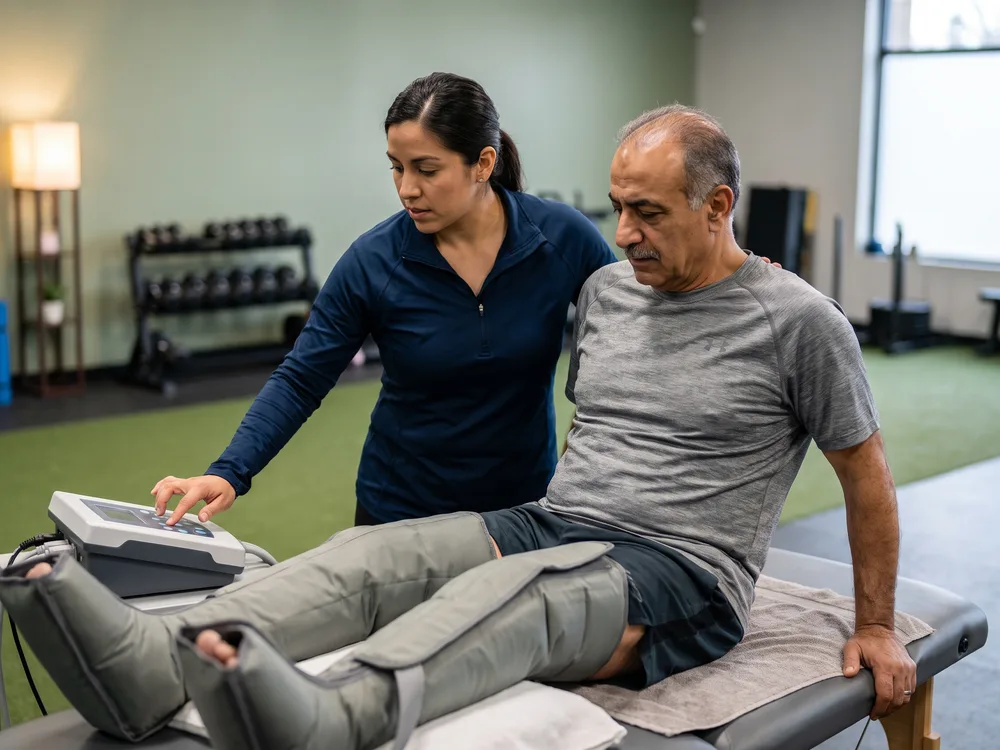
Legs up, chambers cycling, then move again.
Quick Screen
Heavy, swollen legs are not always just training fatigue. Before the boots go on we check your history for the things that make compression a bad idea, and we ask what the leg has actually been doing lately.
Fit and Set the Pressure
The sleeves go on and the pressure gets set to something you can genuinely relax under. More is not better here. You should feel a firm squeeze rolling up the leg, not a pinch you are bracing against.
Run the Cycle, Then Move
The chambers cycle while you sit back. When the boots come off we get you walking again for a few minutes, because your own muscle pump is still the best one you own.
What our patients say.
“I recommend anyone to this group of professionals. My son has received nothing but 5 stars physical therapy.”Efrain H. · Google Review
Schedule an Appointment
No referral needed. Texas direct access lets you be treated for up to 30 consecutive business days without one.
Your first visit is a full one-on-one evaluation with a Doctor of Physical Therapy. Tell us what your training week looks like, and leave with a plan.
You’re all set.
We’ll reach out within one business day to confirm your appointment. If you need to speak with us sooner, call us directly.