
Decompression, not compression.
Almost every soft tissue technique pushes down. Cupping pulls up. A cup is placed on the skin and the air inside it is drawn out, creating negative pressure that lifts the superficial layers away from what sits underneath. That is a different mechanical input than pressure, and tissue that has stopped responding to pressure sometimes responds to it.
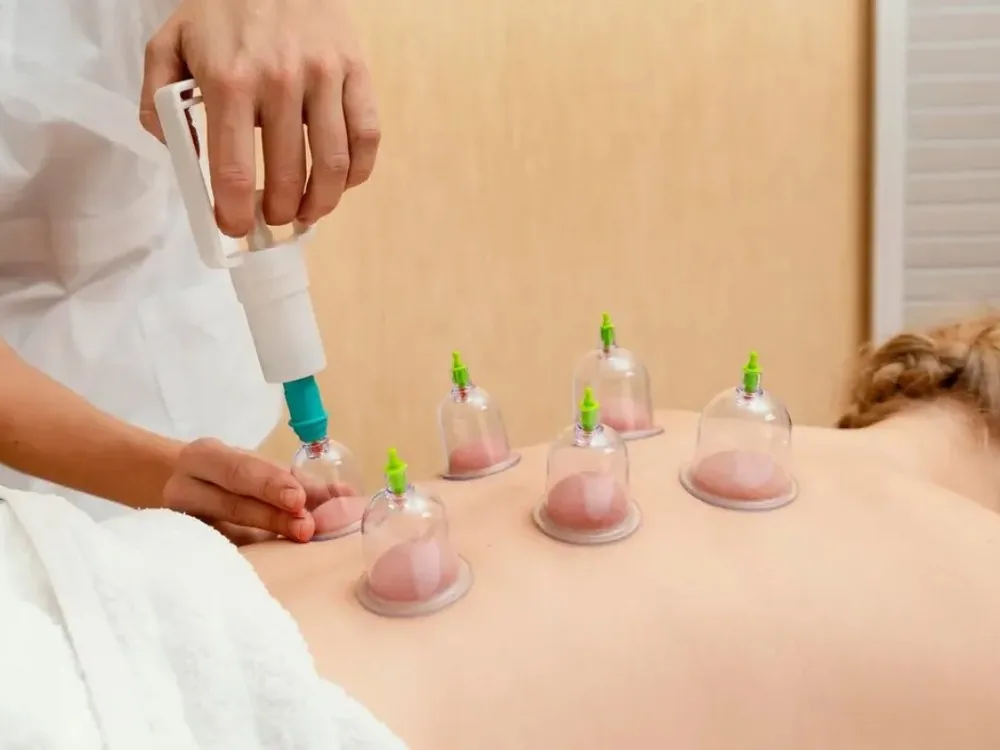
We use it as myofascial decompression. Cups go where your therapist felt a restriction during the assessment, chosen by anatomy rather than by a traditional map. They may sit still over one spot, or glide along a muscle and its fascial line while the suction is held. Either way, it is one part of a session and it is paired with movement, never handed to you as the whole treatment.
Strange sensation, real release.
Assessment and Placement
Your therapist works the region by hand and tests movement to find the tissue that is genuinely restricted. Cups go over those spots. The first pull feels odd, a lifting rather than a pressing, and it settles quickly.
Stationary or Gliding
Cups may stay put over a specific restriction, or slide along the muscle and its fascial line with the suction held. Circular marks often come up afterwards. They are not bruises in the injury sense, and they fade over a few days.
Move It While It Is Open
Then you move. Same range, same pattern, loaded lightly. Tissue that is not asked to use new range tends to give it straight back, so we ask for it before you leave.
What our patients say.
“Highly recommend. Very knowledgeable team and friendly. Always treated with care.”Michael S. · Google Review
Schedule an Appointment
No referral needed. Texas direct access lets you be treated for up to 30 consecutive business days without one.
Your first visit is a full one-on-one evaluation with a Doctor of Physical Therapy. Come in, tell us everything, and leave with a plan.
You’re all set.
We’ll reach out within one business day to confirm your appointment. If you need to speak with us sooner, call us directly.