
Your stride, measured instead of guessed.
Running happens too fast to see. A foot lands and leaves the ground in a fraction of a second, and the eye fills in the rest. 3D gait analysis takes the guessing out. Multi-camera motion capture records you running and rebuilds the stride in three dimensions, so joint angles, cadence, stride length and loading patterns get measured rather than estimated from a video on a phone.
What that gives your therapist is a chain, not a snapshot. An arch that collapses, a hip that drops, a knee that drifts in, a trunk that leans to cover for all of it: that is usually one problem showing up in four places. Seeing the sequence in three planes tells us which link went first. That is the one we train.
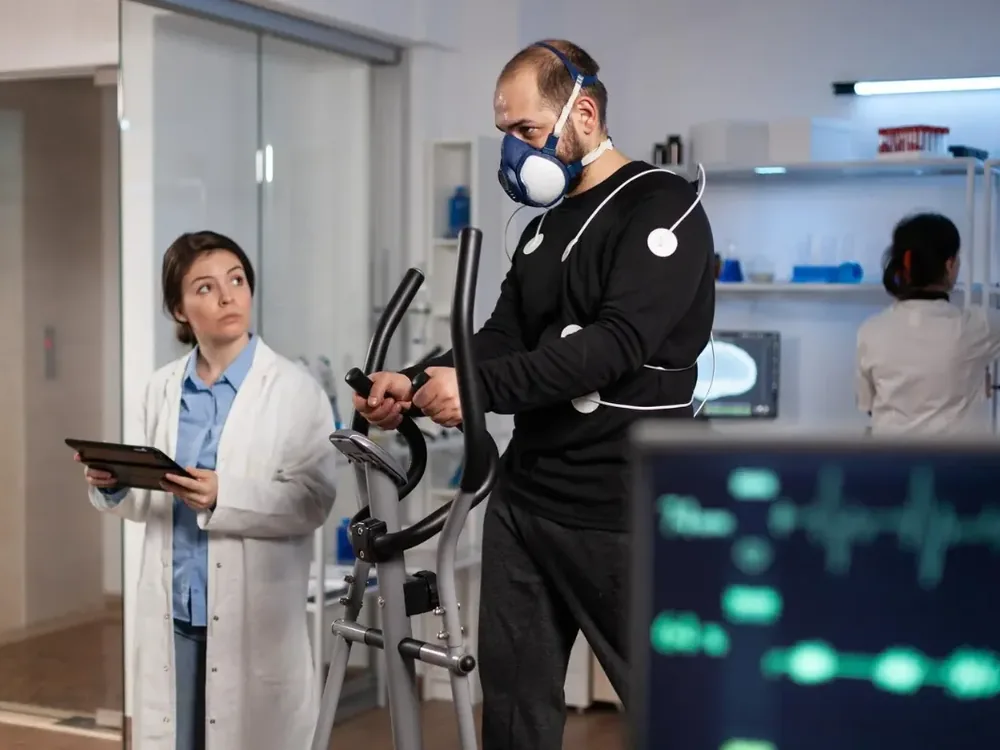
Run it, measure it, then change one thing at a time.
History and Hands-On Screen
We start with your running: mileage, surfaces, shoes, what hurts, when in the run it starts, and what you are training for. Then a hands-on assessment of the joints and tissue that have to tolerate running, before you ever step on the treadmill.
Motion Capture Run
You run at your own paces while the cameras record your stride in three dimensions. We capture an easy effort and a faster one, because mechanics change with speed and a fault that hides at one pace often shows up at another.
Read It Together, Build the Plan
We walk the capture with you on screen and connect what the data shows to what your body has been telling you. You leave with a short list: the cues to change, the tissue to strengthen, and how it phases back into your training.
What our patients say.
“They really helped me get back to 100% and I could not be more appreciative!!!”Alexandra D. · Google Review
Schedule an Appointment
No referral needed. Texas direct access lets you be treated for up to 30 consecutive business days without one.
Your first visit is a full one-on-one evaluation with a Doctor of Physical Therapy. Tell us what you are training for, and leave with a plan.
You’re all set.
We’ll reach out within one business day to confirm your appointment. If you need to speak with us sooner, call us directly.