
The pitch that hurt was not the one that did it.
Throwing a baseball is one of the fastest motions the human body produces, and the arm does not create that speed. The legs and trunk do. The shoulder and elbow are the last links in the chain, and their job is to transfer force and then survive the deceleration. When the legs, hips or thoracic spine stop contributing, the arm makes up the difference. That is where the tissue starts paying.
Two patterns account for most of what we see. On the inside of the elbow, the ulnar collateral ligament and the flexor-pronator muscles resist the valgus stress of late cocking and acceleration, and they get overloaded when volume climbs, mechanics slip, or the athlete throws tired. At the shoulder, the rotator cuff and the tissue around the labrum absorb the deceleration of every throw, and repeated end-range external rotation gradually costs internal rotation. In young throwers the growth plates at the elbow and shoulder are the weak link before the ligaments are. Year-round ball, showcase weekends and pitching on short rest are why arms show up here.
Dr. Andrew Longoria pitched at Texas A&M-Corpus Christi and spent three years coaching high school baseball before earning his Doctor of Physical Therapy. He has been on both sides of the conversation about resting an arm.
Arms rarely fail without warning.
Most throwing injuries announce themselves weeks before anyone stops. Command slips, warm-up takes longer, the arm stays sore into the next day. If any of this sounds like your season, get it looked at while it is still small.
Pain Inside The Elbow
A pinch or ache on the medial side, worst at ball release. The most common complaint we hear from pitchers and catchers.
Deep Shoulder Pain
Pain in the back of the shoulder at lay-back or during the follow-through, often with a feeling that the arm is dragging behind the body.
Velocity And Command Drop
The ball is not coming out the same and it is missing arm side. Performance often changes before pain does.
Lost Internal Rotation
The throwing shoulder no longer rotates in as far as the other one. It is measurable, it is common in throwers, and it is treatable.
Tingling Into The Hand
Numbness or tingling into the ring and little finger, usually the ulnar nerve where it runs behind the elbow. Tell us about this early.
Soreness That Lingers
An arm that used to bounce back by the next morning now takes days. Recovery time between outings is one of the most honest signals a thrower has.
We treat the arm. We rebuild the chain.
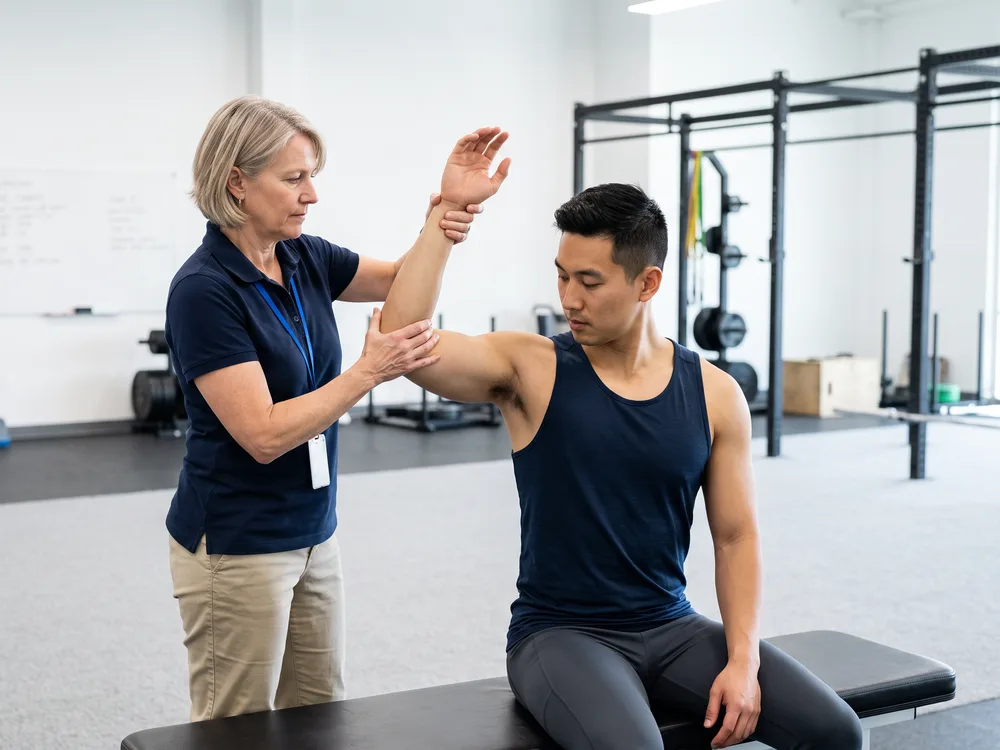
The evaluation is a full one-on-one with a Doctor of Physical Therapy, and it covers more than the sore part. We measure shoulder rotation both directions and compare arms. We look at scapular control, thoracic rotation, hip mobility and single-leg strength. We ask what you actually threw: innings, pitch counts, how many teams, how many showcases, how much rest.
Treatment follows what we find. Hands-on work to restore the rotation and thoracic mobility the delivery needs, needling when the forearm or cuff is guarding, and cuff and scapular loading built back in stages. When you are ready, we run a progressive throwing program from flat ground out to distance and back down to the mound, and we hold the line on volume. If the exam suggests something that needs imaging or a surgeon's opinion, we will say so.
No referral needed. Texas direct access lets us treat you for up to 30 consecutive business days without one.
What our patients say.
"Dr.Jacob helped me through my shoulder pain and pushed me through my first powerlifting season."Justis R. · Shoulder Pain
Schedule an Appointment
No referral needed under Texas direct access, up to 30 consecutive business days.
Your first visit is a full one-on-one evaluation with a Doctor of Physical Therapy. Bring the season: innings, pitch counts, teams, and what the arm has been telling you. You leave with a plan.
You’re all set.
We’ll reach out within one business day to confirm your appointment. If you need to speak with us sooner, call us directly.